

Last Updated: November 1, 2026
Quick Summary
Lab created gemstones are grown in controlled laboratories to match the chemical composition and crystal structure of natural stones, without mining. Their main benefits are predictable color and clarity, documented origin, and a lower price. Moissanite, a lab-grown stone, offers strong brilliance and everyday durability.
- Lab-grown stones have the same chemical composition and crystal structure as their natural counterparts.
- Moissanite rates 9.25 on the Mohs scale, which makes it very hard and suitable for daily wear.
- Bee-Bees moissanite is 100% lab-grown, conflict-free, and carries GRA certification.
- Our D color, VVS1 clarity moissanite stones are colorless and very nearly free of visible inclusions.
- Ask the seller how stones are produced, since lab-grown does not automatically mean low environmental impact.
Table of Contents
- What Lab Created Gemstones Are and Why They Matter
- Are Lab-Created Gemstones Real? How They Are Made
- Lab-Created Gemstones vs Natural Gemstones: The Key Differences
- Ethical Sourcing and Environmental Benefits
- Moissanite vs Diamond Appearance: Brilliance, Color and Clarity
- Durability, Affordability and Value for Everyday Wear
- How to Care for Lab-Created Gemstone Jewelry and Choose Your Piece
- Frequently Asked Questions
What Lab Created Gemstones Are and Why They Matter
Lab-created gemstones are stones grown in controlled laboratory environments that replicate the chemical composition, crystal structure, and optical properties of their natural counterparts. When you choose a lab-created gemstone, you get the same physical character as a mined stone, produced without the environmental footprint and supply chain uncertainty of traditional mining. At Bee-Bees, we focus on moissanite, a lab-grown gemstone prized for its brilliance and durability, and we believe the benefits of lab created gemstones are now clear enough to shape how thoughtful buyers choose their jewelry.
The category matters because buyers increasingly want to know where their stones come from. Our moissanite pieces are 100% lab-grown and conflict-free, and each stone carries GRA certification, so the origin and quality are documented rather than assumed.
Are Lab-Created Gemstones Real? How They Are Made
Yes, lab-created gemstones are real gemstones. They are not imitations or glass. A lab-grown stone has the same crystal structure as its natural equivalent, which is why a trained gemologist can identify it only with specialized equipment.
Growth methods vary by stone. Moissanite is grown from silicon carbide crystals under controlled high-temperature conditions, producing a stone with a higher refractive index than diamond. This is the source of its characteristic fire.
Watch out: a stone being lab-grown does not by itself tell you its quality. Always check the grading report, since color, clarity and cut still determine how a stone looks.
Lab-Created Gemstones vs Natural Gemstones: The Key Differences
The main differences between lab-created and natural gemstones are origin, consistency, cost, and rarity. But the comparison is not the same for every stone. A lab-grown diamond and a lab-grown emerald are produced by different methods, have different market dynamics, and carry different resale expectations. Understanding those distinctions helps you judge what you are actually buying.
Origin and formation. Natural gemstones form over geological time deep in the earth, which is why they carry inclusions, color zoning, and other traces of their journey. Lab-created gemstones are grown in controlled environments that replicate the same chemical composition and crystal structure, but in weeks rather than eons. The result is a stone that is chemically and optically identical to its natural counterpart, but with more predictable color and clarity.
Stone-specific differences. The lab-created category is not monolithic:
-
Lab-grown diamonds are produced by HPHT (high-pressure, high-temperature) or CVD (chemical vapor deposition) methods. They are graded on the same color and clarity scales as mined diamonds and are the most established segment of the lab-grown market.
-
Moissanite is lab-grown silicon carbide, not a diamond simulant in the traditional sense. It has its own optical profile, including higher fire than diamond, and is graded by its own standards rather than the diamond color scale.
Consistency and cost. Cost is one of the most visible differences, since lab production avoids mining. Natural gemstones carry rarity value that lab-grown stones do not, so resale expectations differ by stone type and are worth considering before you buy.
What this means for moissanite buyers. At Bee-Bees, we focus on moissanite because it offers a distinct combination: D color, VVS1 clarity, and a brilliance that stands on its own rather than mimicking diamond. Our stones are 100% lab-grown and conflict-free, and each carries GRA certification so the origin and quality are documented. If you are comparing moissanite to a natural stone, the relevant questions are fire, hardness, and how the stone will look in everyday light, not just the price difference.
The table below sums up how lab-created and natural gemstones differ in origin, production and consistency, as described above.
1ct Round Moissanite Necklace - D Color VVS1 925 Silver with GRA →
| Aspect | Lab-created gemstones | Natural gemstones |
|---|---|---|
| Origin | Grown in controlled laboratory environments | Form over geological time deep in the earth |
| Formation time | Weeks | Eons |
| Inclusions and color zoning | More predictable color and clarity | Carry traces of their geological journey |
| Chemical composition | Same as natural counterpart | Same as lab-created counterpart |
| Rarity value | Lacks the rarity value of natural stones | Carries rarity value |
| Lab-grown diamond methods | HPHT or CVD | Not applicable |
Ethical Sourcing and Environmental Benefits
Ethical sourcing is one of the strongest arguments for lab-created stones, but the benefits are not automatic. They depend on how the stone is produced, where the energy comes from, and how transparent the seller is about the supply chain. A balanced look at the evidence helps you ask better questions.
Labor and community concerns. Our moissanite is 100% lab-grown and conflict-free, and each stone carries GRA certification so the origin is documented rather than assumed.
Environmental impact: what the evidence shows. Environmental claims for lab-created stones are often broad, so it helps to break them down by category:
How to verify ethical and environmental claims. Look for a grading report or certificate that names the stone and its origin. Ask the seller how the stones were sourced and whether they can describe the production method. Our practical steps for verifying ethically sourced jewelry explain what to check. At Bee-Bees, our moissanite is 100% lab-grown and conflict-free, and each stone carries GRA certification. Our ethically sourced moissanite rings guide explains how these rings are sourced and what guarantees apply.
The balanced takeaway. Ethical and environmental benefits of lab-created gemstones depend on how transparent the producer is about its sourcing and production methods.
Moissanite vs Diamond Appearance: Brilliance, Color and Clarity
Moissanite and diamond look similar to most people, but they differ in fire, the flashes of rainbow color that the stone throws off in light. A visual guide to how moissanite looks next to a diamond shows the comparison side by side. Moissanite has a higher refractive index than diamond, which produces its characteristic fire. For a deeper explanation of how the two stones differ in brilliance and fire, see how moissanite and diamond sparkle differ.
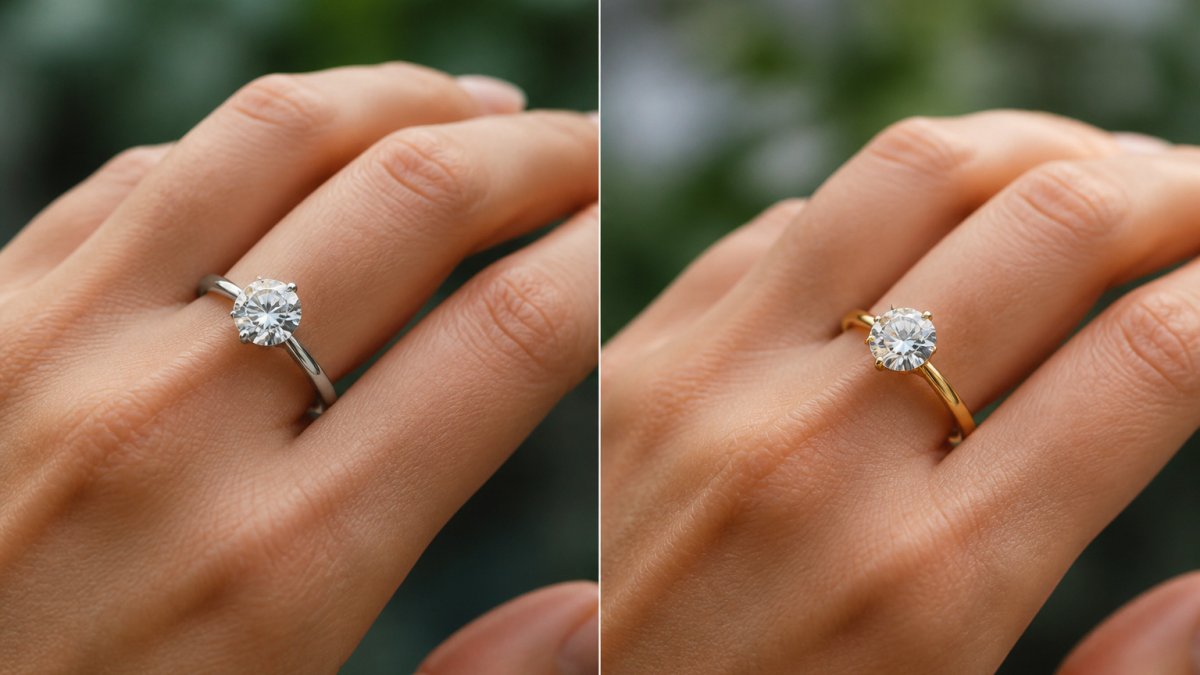
Our moissanite stones are graded D color and VVS1 clarity, which means they are colorless and very nearly free of visible inclusions. Our eternity band uses D color, VVS1 clarity moissanite stones for a bright, icy-white sparkle.
Durability, Affordability and Value for Everyday Wear
Moissanite rates 9.25 on the Mohs scale, which makes it very hard and suitable for daily wear.
Affordability is where moissanite stands out. Moissanite offers the look of a fine stone at an honest price, making everyday luxury more accessible. Our sterling silver pieces are finished with 18k gold or white gold plating and an anti-tarnish protective film.
How to Care for Lab-Created Gemstone Jewelry and Choose Your Piece
Caring for moissanite is simple. Clean your jewelry gently with a soft cloth and warm, mild soapy water, and avoid harsh chemicals, which can dull the plating over time. For step-by-step instructions, see how to clean moissanite at home. Store them separately so the stones do not scratch each other.
When choosing a piece, decide the setting first: a solitaire ring suits an engagement, an eternity band suits stacking, and a pendant suits everyday wear. Then check the grading report and confirm the color, clarity and metal finish match what you want. Our 1ct Round Moissanite Engagement Ring in 925 Sterling Silver is a strong starting point for a classic solitaire, and our 1ct Round Moissanite Necklace offers the same D color, VVS1 clarity in a pendant.
Frequently Asked Questions
What are the benefits of lab-created gemstones?
Lab-created gemstones are chemically and optically the same as their natural counterparts, so they can deliver comparable brilliance. They are produced in controlled environments without large-scale mining, which gives buyers a clearer view of where the stone came from. For everyday jewelry, this combination of visual appeal, affordability and transparent sourcing is the main reason many shoppers choose them.
Are lab-created gemstones real gemstones?
Yes. Lab-created gemstones have the same crystal structure, hardness and chemical composition as natural gemstones, because they are grown under conditions that replicate natural formation. The difference is origin, not authenticity. Lab-created stones are sometimes called synthetic or laboratory-grown, but they are real gemstones. Buyers should look for a grading report or certificate that identifies the stone and its origin, which is the most reliable way to confirm what you are buying.
Do lab-created gemstones look different from natural gemstones?
Lab-created gemstones can look very similar to natural stones, and in many cases they are visually indistinguishable to the eye. Moissanite, for example, has a higher refractive index than diamond, which produces more sparkle and fire. Color and clarity depend on the specific stone and grading. Because appearance alone is not a reliable test, a grading report that states the stone's origin, color and clarity is the best way to understand exactly what you are buying.
How should you care for lab-created gemstone jewelry?
Clean lab-created gemstone jewelry gently with a soft cloth and warm, mild soapy water. Avoid harsh chemicals, which can dull plating and affect the metal over time. Store pieces separately so they do not scratch each other, and remove jewelry before heavy physical activity or cleaning. Regular gentle cleaning keeps the stone bright and the finish looking new, which helps the piece hold its value and appearance for years of everyday wear.