

Table of Contents
- Does Moissanite Look Like a Diamond? The Short Answer
- Moissanite Color Compared to Diamond: Near-Colorless Stones Side by Side
- Moissanite Durability for Everyday Wear: Will It Hold Its Sparkle?
- How Cut and Size Change Whether Moissanite Passes for a Diamond
- What Photos and Videos Can't Show You
- Choosing a Moissanite Ring That Looks Diamond-Like Every Day
- Frequently Asked Questions
Last Updated: October 15, 2026
Does Moissanite Look Like a Diamond? The Short Answer
Yes, moissanite looks remarkably like a diamond to the naked eye, and in some lighting it out-sparkles one.
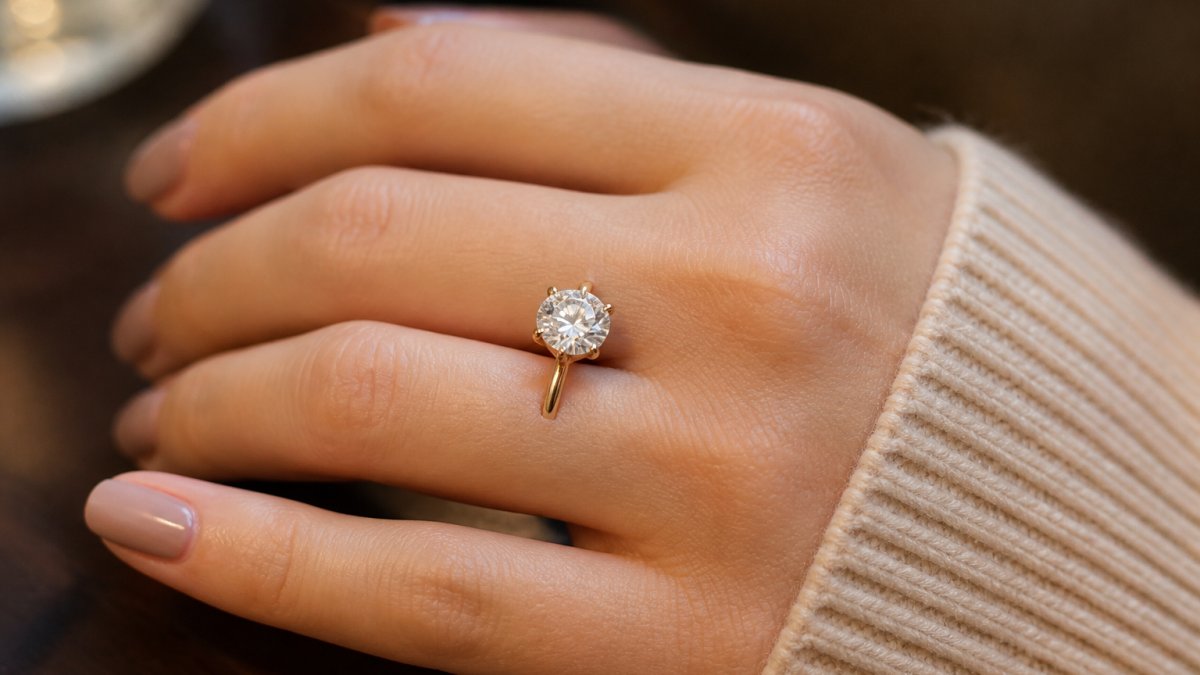
Here's what matters most: a well-cut, near-colorless moissanite set in sterling silver with gold plating will fool almost everyone in a room.
Diamond wins on what the trade calls "brilliance" in the strict sense: the crisp, white light return that makes a diamond look like it has a lightbulb inside it.
Rainbow Flashes, Fire, and the Disco-Ball Effect
Moissanite's higher dispersion means it throws more colored flashes than diamond, skewing toward red, blue, and yellow. Under direct sunlight or strong spot lighting, a large moissanite can produce a disco-ball effect: rainbow-colored points scattered across a room.
Some people love it; some find it too much. If you want quiet, white restraint, diamond is the more subdued choice. If you want maximum visual drama for the money, moissanite delivers it.
Moissanite Color Compared to Diamond: Near-Colorless Stones Side by Side
Moissanite color compared to diamond is where the gap has closed most in recent years.
Side by side under the same light, a D-color moissanite and a D-color diamond look the same in color.
Here at Bee-Bees, every stone we sell is D color and VVS1 clarity, which means the color question is largely settled before you even open the box.
| Feature | Moissanite (D/VVS1) | Diamond (D/VVS1) |
|---|---|---|
| Composition | Silicon carbide | Carbon |
| Refractive index | Higher | Lower |
| Colored flashes | More, rainbow-leaning | Fewer, subtler |
| Mohs hardness | 9.25 | 10 |
| Color at top grade | Colorless | Colorless |
| Everyday durability | Excellent | Excellent |
| Relative cost | Lower | Higher |
Moissanite Durability for Everyday Wear: Will It Hold Its Sparkle?
Moissanite durability for everyday wear is excellent. Moissanite rates 9.25 on the Mohs scale, just below diamond's 10, harder than sapphire, ruby, and every other common gemstone.
But hardness is only half the story. What most guides skip is how the stone looks after years of wear, and what you actually need to do to keep it looking that way.
How Moissanite Appearance Holds Up Over Time
The stone itself is remarkably stable. Moissanite doesn't cloud, yellow, or lose its refractive properties with age, and it keeps its facet sharpness and light return for decades.
What does change over time is the metal and the underside of the stone.
A common pattern we hear from customers: after six to twelve months of daily wear, the ring looks less sparkly than they remember.
The Maintenance Routine That Actually Works
You don't need a jeweler for routine care. Here's what works:
- Weekly: A quick wipe with a soft lint-free cloth removes surface oils before they bake on.
- Monthly: Warm water with a drop of mild dish soap, a soft-bristle toothbrush, and gentle scrubbing around the prongs and under the stone. Rinse and pat dry.
- Avoid: Harsh chemicals, ultrasonic cleaners (unless your jeweler confirms the setting is secure), and wearing the ring during heavy cleaning, gardening, or gym sessions where it could get knocked.
For sterling silver with gold plating, the plating needs the most attention. Gold plating can wear thin over time, especially on the underside of the band. A reputable seller will offer re-plating services, or a local jeweler can refresh it. This is normal wear, not a defect.
What About the Stone Itself?
Moissanite's hardness means the stone keeps its sparkle for decades. It won't scratch from normal wear or lose its fire, so the maintenance you need is cleaning, not repair.
The takeaway: moissanite is low-maintenance, but that doesn't mean no maintenance. A two-minute cleaning once a month keeps it as brilliant as the day you bought it.
How Cut and Size Change Whether Moissanite Passes for a Diamond
Cut matters more than any other factor in whether a moissanite passes for a diamond.
1ct Round Moissanite Engagement Ring - 925 Sterling Silver GRA Certified →
Look for an 8 Hearts & Arrows cut if you want the most diamond-like performance. This cut is engineered for perfect symmetry and maximum light reflection.
Size plays a quieter role. Smaller stones, under about 1 carat, are hard to distinguish at all because there's less surface area for the colored flashes to show.
What Photos and Videos Can't Show You
Photography and video flatten the very thing that separates these stones. A camera captures a single instant of light behavior, it cannot show how a stone responds as you move your hand, how flashes shift with angle, or how it looks in dim restaurant lighting versus midday sun.
This is why buying a moissanite ring online can feel risky, and why it shouldn't. The properties that make moissanite look like a diamond are dynamic, and no product photo captures them fully.
Why Phone Cameras and Social Media Mislead
There are three specific reasons your phone screen isn't telling you the truth about moissanite:
- Dynamic range compression. Cameras struggle to capture the full range of bright highlights and deep shadows in a faceted stone. The result is either blown-out white spots where the sparkle should be, or a flat, lifeless image that undersells the stone.
- Display settings. Your phone or monitor is calibrated for general content, not gemstones. Color temperature, saturation, and brightness settings can make a moissanite look warmer, cooler, or more rainbow-heavy than it appears in person.
- Video frame rate. Moissanite's fire is most visible in motion, the way colored flashes dance as the stone tilts. A 30fps video samples that motion too slowly to capture the full effect, and compression artifacts can smear the flashes into a blur.
The practical result: a moissanite that looks stunning in person can look dull in a photo, and one that looks subtle in person can look like a disco ball in a heavily edited video. Neither is accurate.
How to Actually Compare Moissanite and Diamond Side by Side
If you want to know how moissanite looks next to a diamond, you need to control the lighting. Here's how to do it:
- Daylight (overcast or indirect): The most neutral condition. Both stones look their most diamond-like, and moissanite's fire is present but not overwhelming. This is the lighting most people encounter daily.
- Direct sunlight: Moissanite's rainbow flashes become obvious here. Diamond throws white and colored light, but moissanite's dispersion produces stronger red, blue, and yellow points. If you love fire, moissanite wins; if you prefer subtlety, this is where it stands out most.
- Indoor ambient lighting (warm bulbs): Both stones pick up the room's warm tone. Moissanite can lean slightly warmer than diamond, but at D color the difference is minimal.
The honest answer: in most lighting, most people can't tell. In direct sun or under spotlights, moissanite's fire is more noticeable. In dim light, diamond has a slight edge in white brilliance. Neither stone "wins" across all conditions.
What to Do When You Can't See It in Person
The workaround is to buy from a seller who offers clear grading, a certificate, and a return policy. Look for GRA certification, which verifies the stone's grade and specifications, then judge the ring on your own hand, in your own light.
If you're comparing online, look for videos that show the stone in multiple lighting conditions, not just the heavily edited hero shot.
Choosing a Moissanite Ring That Looks Diamond-Like Every Day
If looking diamond-like is your goal, here's how we'd approach the decision:
- Go D color, VVS1 clarity. Top-grade stones remove the color and clarity tells entirely.
- Choose a precision cut. An 8 Hearts & Arrows round brilliant is the most diamond-like cut available.
- Stay near 1 carat. It's large enough to impress and small enough to avoid the disco-ball effect.
Our 1ct Round Moissanite Engagement Ring hits every mark: D color, VVS1 clarity, 8 Hearts & Arrows cut, set in 925 sterling silver with 18k white gold plating, and GRA certified. If you want to start smaller, the Classic Round Moissanite Solitaire Ring comes in 0.5ct through 3ct.


The 1ct Round Moissanite Engagement Ring comes with a protective AF film that keeps the metal water-resistant and non-fading, which matters if you plan to wear the ring daily.
Frequently Asked Questions
Do moissanite stones look fake compared to diamonds?
A well-cut moissanite with a D color grade and VVS1 clarity does not look fake. It looks like an exceptionally bright white stone. The main giveaway is extra fire, meaning more rainbow-colored flashes than a diamond shows. In normal daily settings, most people read that extra sparkle as simply beautiful, not imitation. The stones that look off are usually lower color grades with a yellow or gray tint, which is why D color matters.
Can you tell the difference between moissanite and diamond without a jeweler's tools?
Sometimes, but not reliably. A loose stone viewed side by side under bright light shows moissanite's stronger rainbow flashes, which is the clearest visual clue. Once a stone is set in a ring and worn on a hand, casual observers rarely spot it. Trained jewelers use magnification and a diamond tester, and moissanite is known to pass many handheld testers, so even professionals rely on equipment rather than the naked eye.
Does moissanite sparkle more than a diamond?
Yes, in most lighting. Moissanite has a higher refractive index than diamond, so it bends and returns more light, and its higher dispersion splits that light into more visible color. The practical result is more fire, especially under direct light or camera flash. Some buyers love the extra liveliness; others prefer the more restrained white brilliance of a diamond. Neither is wrong, it is a taste decision.
Will moissanite hold up to daily wear and keep its sparkle?
Moissanite rates 9.25 on the Mohs scale, so it resists scratching in everyday conditions and suits continuous wear. It does not fade or cloud over time. The parts that need attention are the setting and the metal finish, not the stone. Clean it with a soft cloth and warm, mild soapy water, avoid harsh chemicals, and have prongs checked periodically. Bee-Bees rings add an AF protective film and 18k gold plating over 925 sterling silver to resist tarnish.
The real challenge with moissanite isn't whether it looks like a diamond. It's choosing a stone that's cut, graded, and set well enough to look its best every single day. Bee-Bees makes that decision simpler: D color and VVS1 clarity as standard, GRA-certified stones, 925 sterling silver with 18k gold plating, and an AF protective film built for daily wear. Browse our collection and find a ring that captures light the way you want to be seen.