

Last Updated: November 5, 2026
Quick Summary
The best moissanite alternatives for bridal jewelry are cubic zirconia, lab-grown diamond and white sapphire, each trading fire, hardness and price differently. Moissanite itself offers strong fire and 9.25 Mohs hardness, making it well suited to everyday wear. Choose by which quality matters most to you.
- Moissanite rates 9.25 on the Mohs scale, well suited to everyday wear when prong-set.
- Cubic zirconia is cheap and bright but its fire is softer and it scratches more easily.
- Lab-grown diamond is chemically identical to mined diamond and is the hardest option compared.
- White sapphire offers good white brilliance with less fire and very strong hardness at 9 Mohs.
- Ask for a recognised laboratory certificate, such as a GRA report, to verify any stone's grade.
Table of Contents
- Why Shoppers Look for Moissanite Alternatives in Bridal Jewelry
- How We Compared the Options: Brilliance, Durability, Ethics and Cost
- Moissanite vs Cubic Zirconia: Which Looks Closer to a Diamond?
- Moissanite vs Lab-Grown Diamond: Sparkle, Price and Origin Compared
- Durable Gemstones for Engagement Rings Worth Considering
- Ethical Diamond Alternatives and What Sourcing Claims to Check
- Choosing Your Bridal Ring: Shape, Setting and Budget Next Steps
- Frequently Asked Questions
This guide covers moissanite alternatives for bridal jewelry, because many shoppers want the look of a diamond without the mined-stone price tag or the sourcing questions. Moissanite is the most common choice, but it is not the only one, and each option trades brilliance, hardness and cost differently. Below, we compare the options that matter most for an everyday engagement ring, and we point you toward Bee-Bees pieces where moissanite fits your needs. Our aim is to help you choose with confidence, not to push a single answer.
Why Shoppers Look for Moissanite Alternatives in Bridal Jewelry
Many buyers start looking for alternatives because natural diamonds are costly, and the mining supply chain is hard to verify. A moissanite alternative lets you keep the sparkle and the classic solitaire look while adjusting the budget and the sourcing story. The right stone depends on what you value most: fire, hardness, price, or origin.
Gemological Institute of America guide to diamond and gemstone grading
Think about how the ring will be worn. A stone for daily wear needs enough hardness to resist knocks, while a stone for occasional wear can prioritize optical effect. Keep that trade-off in mind as you read the comparisons.
How We Compared the Options: Brilliance, Durability, Ethics and Cost
Each option can be judged on four practical criteria: how much light and fire the stone returns, how well it resists scratches and chips in daily wear, how transparent its origin is, and how the finished ring feels as an everyday piece.
Brilliance and fire. Brilliance is the white light returned to the eye; fire is the rainbow flash split from that light. Moissanite has a higher refractive index than diamond and a notably higher dispersion, so it produces more visible fire, especially under point lighting and in photographs. Cubic zirconia is bright but its fire is softer and more uniform. White sapphire returns good white brilliance but comparatively little fire. Lab-grown diamond sits closest to natural diamond in both measures. A useful way to judge this is to view each stone under the same three lighting conditions: diffuse daylight, warm indoor light, and a single overhead spot.
Durability for everyday wear. Hardness resists scratching; toughness resists chipping. Moissanite at 9.25 on the Mohs scale is harder than most gemstones used in bridal jewelry and is well suited to daily wear when set with protective prongs. White sapphire at 9 is also very hard. Cubic zirconia is softer and will show surface wear sooner. Lab-grown diamond is the hardest of the group. Hardness alone is not the whole story: a stone with an exposed girdle or a thin prong can chip regardless of its Mohs rating, so setting choice matters as much as the mineral.
Ethics and origin. Lab-grown moissanite, lab-grown diamond, and cubic zirconia all have traceable lab origins. White sapphire may be natural or lab-grown, and natural supply chains vary. For any stone, ask for documentation of where it was made or mined and whether it is independently certified. A recognized laboratory report gives you a verifiable reference point for color and clarity.
Everyday luxury affordability. Instead of quoting prices, which vary by size, cut, and setting, we compare how each option behaves as a long-term purchase: how often it needs professional attention, how easily it can be replaced if lost, and how well it holds its appearance through daily wear. Moissanite in D color and VVS1 clarity set in sterling silver with gold plating is a combination offered by Bee-Bees, delivering a colorless, icy-white look with strong fire.
| Option | Brilliance and Fire | Daily-Wear Durability | Origin | Ownership Notes |
|---|---|---|---|---|
| Moissanite (D, VVS1) | High fire, rainbow flashes; strong white brilliance | Strong (9.25 Mohs); prong setting recommended | Lab-grown | Holds appearance well; routine cleaning keeps fire visible |
| Cubic zirconia | Bright, softer fire; more uniform | Moderate; surface wear over years | Lab-grown | May need replacement sooner with daily wear |
| Lab-grown diamond | Close to natural diamond in brilliance and fire | Very strong | Lab-grown | Requires certification for grade verification |
| White sapphire | Good white brilliance, less fire | Very strong (9 Mohs) | Natural or lab-grown | Natural origin needs documentation |
A common pattern is that buyers who prioritize fire choose moissanite, buyers who prioritize a diamond-identical look choose lab-grown diamond, and buyers who prioritize a cool white look with lower fire choose white sapphire. The table is a starting point, not a verdict: view stones in person or in consistent photography before deciding.
Moissanite vs Cubic Zirconia: Which Looks Closer to a Diamond?
Cubic zirconia is cheap and very bright, but its fire is softer and it tends to look more uniform under light. Moissanite produces stronger flashes of color, which many people find closer to a natural diamond's sparkle. Cubic zirconia is also softer, so it scratches more easily over years of wear.
If your priority is the lowest price, cubic zirconia is a reasonable choice. If you want the stone to keep its look through daily wear, moissanite is usually the better match. Our D color, VVS1 clarity moissanite stones are graded to give a colorless, icy-white appearance.
Moissanite vs Lab-Grown Diamond: Sparkle, Price and Origin Compared
Lab-grown diamond is chemically identical to a mined diamond, so it looks like one in almost every respect (How do I identify laboratory-grown diamonds?). Moissanite is a different mineral with its own character: more fire, slightly more color flash, and a lower price per carat. Most buyers who choose moissanite do so for value, not because they cannot tell the two apart. To see how the stones compare in more detail, read our guide to moissanite engagement ring options and what to compare.
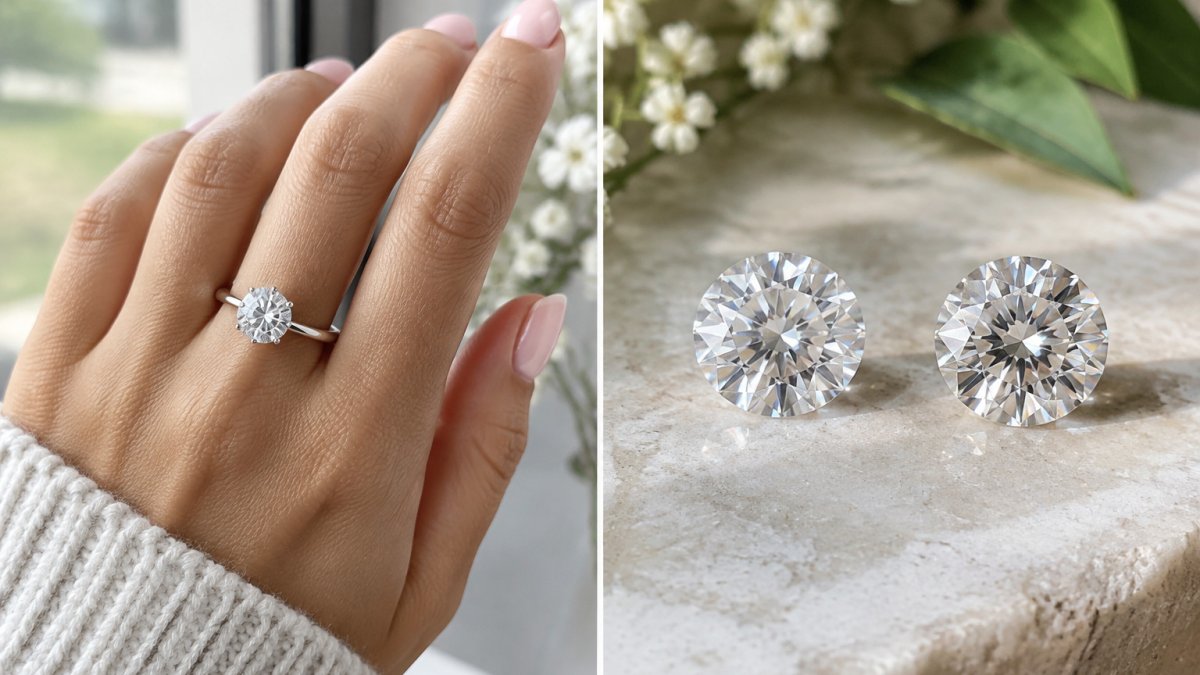
Both options are lab-created, which speaks to the origin question. The price gap is the main reason shoppers pick moissanite. For a closer look at the trade-offs, read our guide to choosing lab-created gemstones and their benefits.
!A bride's hand wearing a round moissanite solitaire in sterling silver, in soft daylight
GRA Certified 2CT Emerald Moissanite Engagement Ring - S925 Silver →
Durable Gemstones for Engagement Rings Worth Considering
A durable stone should hold its polish and resist chipping through years of daily wear. Hardness matters, but so does toughness, cleavage, and the setting that holds the stone. A prong setting protects the stone's edges and spreads impact away from the girdle, while a sturdy sterling silver band with gold plating keeps the ring comfortable and resists tarnish on the parts that touch the skin. You can read more about whether moissanite holds up to daily wear.
Beyond moissanite, the stones most often considered for bridal rings are white sapphire, lab-grown diamond, and cubic zirconia. White sapphire is very hard and takes a high polish, but it has less fire than moissanite and can look slightly glassy in low light. Lab-grown diamond is the hardest of the group and behaves like natural diamond in wear. Cubic zirconia is the softest of the common options and will show fine surface scratches sooner, especially on the table facet.
Long-term wear and maintenance. Cleaning routine has a large effect on how a stone looks over time, since oils from skin and hand lotion dull the underside of any stone. Oils from skin and hand lotion dull the underside of any stone, and a stone with strong fire like moissanite shows the difference quickly. A soft brush, warm water, and a mild soap, used weekly, keeps the fire visible. Avoid harsh chemicals around plated metals.
Repair and replacement. Prongs can wear down over time, so it is worth having a jeweler check them periodically. A thin prong is the most common cause of a chipped girdle, regardless of stone type. Ask whether the setting can be re-tipped and whether the stone can be replaced if lost; moissanite and cubic zirconia are both replaceable, while a lab-grown diamond replacement should be matched on certificate.
Shape and cut considerations. Durability interacts with shape. Round stones have no sharp corners and are the most forgiving in daily wear. Oval and pear shapes concentrate wear at the tips, so a prong or a bezel at the point is worth specifying. Emerald cuts have long, flat facets that show scratches and dulling more readily than a brilliant cut, so they benefit most from regular cleaning. Marquise shapes have two points and need protective settings at both ends.
Watch out: a stone can be hard on the Mohs scale and still chip if the girdle is exposed or the prongs are thin, so judge the setting as carefully as the mineral.
For readers comparing moissanite specifically, our D color, VVS1 clarity stones are cut to return strong fire and are set in sterling silver with gold plating, which keeps the ring comfortable for everyday wear while preserving the icy-white look that bridal shoppers tend to prefer.
Ethical Diamond Alternatives and What Sourcing Claims to Check
Ethical sourcing is a reasonable concern for many buyers. When you evaluate any alternative, ask for documentation of where the stone was made and whether it is independently certified. Certification from a recognized laboratory, such as a GRA report, gives you a verifiable reference point for the stone's grade.
Bee-Bees stones are lab-grown and conflict-free, and each ring includes a GRA certificate. Always confirm the certificate matches the stone you receive before you finish the purchase.
Choosing Your Bridal Ring: Shape, Setting and Budget Next Steps
Start with the shape you like most. Round stones maximize brilliance, oval and pear shapes look longer on the finger, and emerald-cut stones give a calm, hall-of-mirrors effect. Then choose a setting that protects the stone for daily wear, and set a budget that includes the band and certificate.
Bee-Bees carries several options worth browsing, including the 2CT Oval Moissanite Engagement Ring in 925 sterling silver and our full engagement ring collection in D color, VVS1 moissanite. Compare the specifications, pick the shape that suits you, and choose the ring that fits your budget and everyday routine.

Frequently Asked Questions
Is there anything better than moissanite?
Whether moissanite is the best choice depends on what you value most. Moissanite is harder than cubic zirconia and reflects more fire than a diamond, which makes it a strong option for everyday bridal wear. Lab-grown diamonds match diamonds chemically and cost more, while sapphires offer exceptional durability in many colors. Bee-Bees moissanite rings, such as the 1ct round solitaire with D color and VVS1 clarity, are a practical choice if you want high brilliance with a sterling silver band and gold plating at an accessible price.
Is moissanite ok for a wedding ring?
Yes, moissanite is widely worn in wedding rings. It rates 9.25 on the Mohs hardness scale, which means it resists scratches well for daily use. Because it is lab-created and conflict-free, many buyers choose it for ethical reasons as well. Bee-Bees rings such as the 3-stone moissanite engagement ring suit a wedding setting, and each stone comes with a GRA certificate so you can confirm what you are buying.
How does moissanite compare with cubic zirconia?
Moissanite and cubic zirconia both work as diamond alternatives, but they differ in brilliance and hardness. Moissanite has a higher refractive index and more fire, so it shows colorful flashes of light. Cubic zirconia is softer and can show wear sooner with daily use. For a bridal ring meant to last, moissanite offers greater hardness and fire than cubic zirconia.
Are lab-grown diamonds a good alternative to moissanite?
Lab-grown diamonds are real diamonds made in a laboratory, so they share the chemistry and hardness of mined diamonds. They generally cost more than moissanite of similar size. Moissanite is a different mineral with more fire and a lower price. If you want a diamond look at a lower budget, moissanite is often the choice; if you want an actual diamond with lab origin, a lab-grown stone fits better.
Bee-Bees makes it easy to find a moissanite ring that balances brilliance, durability and everyday affordability. Browse the collection to find a ring that suits your style, and get in touch if you have questions about sizing or certification.